
Jobs to Inbox is a participant in the Amazon Services LLC Associates Program. When you buy through links on this page we may earn a commission, at no extra cost to you. We choose every product ourselves and we are never paid to include one. How we pick.
Choose a format that puts relevant evidence first
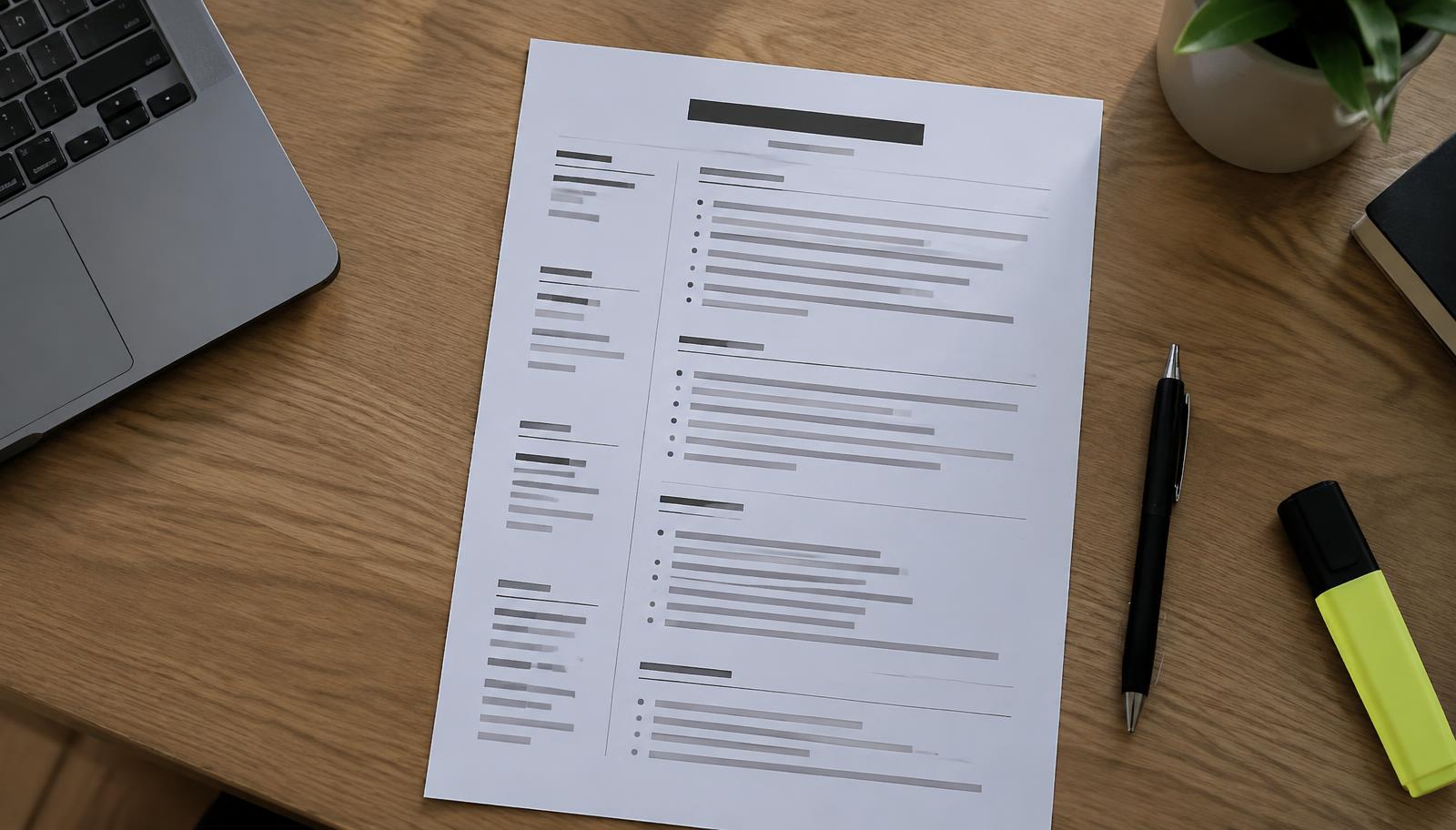
A remote-job resume should make your qualifications, work location, and ability to deliver without constant supervision easy to verify. Start with a reverse-chronological format: contact information, a short summary when useful, experience, skills, and education or certifications. Put your most recent role first, with consistent dates and accomplishments beneath each position. This gives readers a familiar structure while showing whether your experience matches the actual work. A functional format that separates skills from employment dates can make your background harder to evaluate, especially when the application also requests a complete work history. A straightforward document usually serves you better than an elaborate layout.
If you are writing your first resume, begin in a standard document editor with a single-column page. Use a readable font around 10.5 to 12 points, slightly larger headings, and margins that leave enough white space for comfortable reading. Create ordinary text headings rather than text boxes, and use paragraph settings instead of repeated spaces to align information. Include paid work, substantial class projects, volunteering, or other relevant experience, clearly labeled so nobody mistakes a project for employment. Save an editable master copy before exporting the file type the application requests. Good formatting should survive revision, not collapse whenever you add another line.
Make your resume stand out by reducing the effort required to understand your fit. A weak resume often leaves the reader unsure of the target role, strongest skill, or most recent employment. Decorative rating bars, oversized initials, and a photograph consume space without establishing that you can do the job. Even when you find an opening through a remote-job email service, your resume still needs to demonstrate the qualifications required for that particular role. A customer support application might emphasize resolving account problems and communicating clearly, while a software development application might highlight relevant technologies and improvements to application performance. Write for a specific occupation and level, not for “remote work” as though it were a job title.
Make your contact line and location unambiguous
Your contact line should contain your name, professional email address, phone number, and a truthful location. City and state are usually enough; you generally do not need a street address, apartment number, or other unnecessary personal information. Remote employers may restrict hiring by state because of payroll registration, employment law, licensing, or contract requirements. Leaving location off does not remove those restrictions and can create an extra screening question that delays your application. If the position specifies approved states, confirm that your actual work location qualifies before spending time rewriting the entire document. A polished resume cannot resolve a genuine geographic eligibility mismatch.
A simple contact line can read, “Morgan Lee | City, State | Phone | Email | Portfolio URL,” with your own details replacing each placeholder. You can add “Eastern time” when schedule overlap matters, but a time zone does not replace your state of residence. If you will relocate, state the destination and expected date only when you have a concrete plan you can explain. Do not claim to live somewhere merely because you could theoretically move there after receiving an offer. Work authorization belongs on the application when requested; a short resume note can help when authorization is relevant and you can describe it accurately. Avoid including identity-document numbers or other sensitive proof in the resume itself.
Use the rest of the contact area to remove practical uncertainty, not to advertise your desire to avoid commuting. A relevant portfolio link can help a writer, designer, analyst, or developer when the samples are accessible and do not expose confidential work. Test the link in a signed-out browser session, because a permission screen can make your strongest evidence effectively invisible. For licensed professions, list the applicable credential and jurisdiction in the certification section rather than crowding the top line with unexplained letters. Mention schedule availability only when it meaningfully supports a stated requirement, such as evening coverage or overlap with a distributed team. An incorrect phone number, inaccessible sample, or misleading location can cost you consideration even when the rest of the document is strong.
Write a focused professional summary
A resume summary briefly explains the relevant experience and strengths you already bring. It usually works best in two or three lines, not a dense paragraph full of personality claims. Name your occupation or credible specialization, add one or two requirements you meet, and finish with evidence that supports your level. The summary should help readers interpret the experience below, rather than introduce accomplishments that never appear again. If you cannot add information beyond “motivated professional seeking a remote opportunity,” omit the summary and give that space to experience.
Compare these illustrative before-and-after summaries, using only details you can substantiate in your own version. Before: “Hardworking customer service professional with excellent communication skills seeking a challenging remote position.” After: “Customer support specialist with four years of phone and email experience, including billing disputes and account access; maintained documented quality scores above 95% while handling an average of 45 cases daily.” The revision replaces broad praise with scope, relevant problems, and performance evidence, while leaving the employer to judge whether those details meet its needs. If you do not have reliable quality scores, substitute defensible evidence such as escalation responsibility, languages used professionally, or experience explaining regulated products. Never borrow the example’s numbers merely because they sound convincing.
A resume summary generator can help shorten a draft, but it cannot establish that your claims are accurate or appropriate for the target position. Give any writing tool verified facts, then check that it has not upgraded your seniority, invented metrics, or turned occasional exposure into expertise. For a career transition, connect previous work to the new role through shared tasks, such as documentation, analysis, scheduling, or resolving customer problems. Avoid calling yourself an experienced project manager if you coordinated one event but never owned a project schedule, budget, or delivery process. You can instead describe the actual coordination work and the outcome it produced, which gives the reader something concrete to assess. Write the summary after the experience section so that it reflects the strongest evidence you actually have.
Use resume objectives only when they clarify a transition
A resume objective is a short statement of your target role and relevant preparation. It explains where you intend to contribute, while a summary emphasizes the experience and strengths you already bring. An objective can be useful when your background does not make your direction obvious. First-job applicants can use it to connect coursework or projects to a role; career changers can highlight transferable experience. It is less useful when your recent title and accomplishments already establish exactly what you do.
A customer service resume objective might read, “Seeking an entry-level remote support role using two years of retail problem-solving experience, accurate transaction handling, and written communication.” This does not pretend that retail work was remote support, but it identifies transferable preparation that a hiring team can investigate. Strong resume objective statements describe what the applicant can contribute instead of requesting flexibility, advancement, or a supportive environment. When reviewing sample objectives, reject any template that could describe almost every applicant in almost every field. Choose wording that identifies a realistic target and connects it to specific evidence from your background. Keep it brief enough that your experience remains the main attraction.
The role of an objective in resume writing is clarification, not compensation for missing mandatory qualifications. Build your objective around the work you want to perform and the preparation you can demonstrate today. For example, a teacher moving into learning coordination could emphasize instructional materials, participant scheduling, and written feedback without claiming prior corporate training experience. A medical assistant seeking a remote administrative role could emphasize appointment coordination and patient communication, while avoiding claims of independent clinical assessment. Neither applicant needs both an objective and a summary, because those sections would usually repeat one another. If a position requires a license, degree, or specific experience that you lack, enthusiastic wording will not remove that requirement; focus instead on roles whose mandatory qualifications you meet.
Turn experience bullets into evidence of useful work
Experience entries should show your title, employer, dates, and the work that establishes your fit for the position. Beneath each entry, use concise accomplishment bullets that combine an action, a relevant task or problem, and an outcome or meaningful scope. Not every accomplishment needs a percentage, and a made-up metric is worse than a truthful description of responsibility. Before using a number, ask whether you could explain its source, time period, and your contribution during an interview. The examples below are illustrative transformations, not claims you should copy unchanged. They show how to replace vague duties with evidence across several fields.
For customer support, change “Answered customer questions” to “Resolved billing and account-access requests across email and phone, documenting escalation context so customers did not have to repeat the issue.” For administrative work, change “Managed calendars” to “Coordinated interviews across three time zones and sent consolidated agendas, reducing preventable scheduling conflicts.” For software development, change “Worked on application performance” to “Reduced median report-loading time from 4.2 to 2.6 seconds by removing duplicate database queries.” Use that technical result only if you actually measured it under comparable conditions and can explain what changed. For teaching, replace “Taught online lessons” with “Adapted weekly lessons for live and asynchronous instruction, using assignment results to identify students needing additional practice.” Each revision makes the work more concrete without assuming that remote experience alone proves competence.
For nursing, “Provided patient support” could become “Completed scheduled telephone assessments within licensed scope, documented findings, and escalated symptoms according to established clinical protocols.” For remote nursing roles involving patient care, confirm that your license or compact privilege authorizes practice where the patient is located, and list the relevant jurisdictions accurately. For medical assisting, describe the actual authorized administrative or clinical support tasks rather than implying authority to diagnose, triage independently, or make treatment decisions. A resume bullet point generator can propose clearer verbs, but you must verify every duty, metric, and implication of clinical or technical responsibility. Show remote readiness through documented handoffs, asynchronous updates, secure information handling, and dependable follow-through where those were genuinely part of your work. “Worked from home” describes a location; explaining how you kept work moving describes a qualification.
Make skills, education, and certifications verifiable
Your skills section should help a reader confirm capabilities that the role actually requires, not display every tool or topic you have encountered. Group related skills in plain language, such as spreadsheet analysis, customer correspondence, scheduling, technical troubleshooting, or clinical documentation. Include specific technologies when the application requires them and you can discuss your actual level of use. Avoid visual proficiency meters because “four out of five” has no shared meaning and may not translate well into extracted text. Support important skills with an experience bullet or project that shows how you applied them. A claim becomes much stronger when the reader can connect it to work you completed.
Education entries generally need the credential, institution, and relevant field of study, with graduation timing when it helps establish your current stage. You can usually omit an older graduation year if it is not requested, but application questions still require accurate answers. For unfinished study, describe completed coursework or an expected graduation date truthfully rather than presenting an unearned degree. Relevant certifications should include the credential name, issuing organization, and expiration date when currency matters for the work. Professional licenses should identify the applicable jurisdiction and status without exposing unnecessary personal identifiers. A short online course should not be labeled a professional certification unless it actually awards that credential.
Briefly explain specialized credentials for readers outside your field, but preserve the accurate credential name in the education or certification section. Explain unfamiliar acronyms once when the expansion helps a general recruiter understand your qualification and its relevance. For a first job, a relevant project can establish preparation through its deliverable, your individual contribution, and the methods you used. For example, describe creating a sample scheduling workflow with conflict checks rather than claiming professional operations experience based solely on a course exercise. Do not add “expert” to a skill you would struggle to demonstrate in a basic practical assessment, because the mismatch can end an otherwise promising interview. Requirements involving secure workspaces, reliable connectivity, or certain equipment are best confirmed accurately in the application; they rarely deserve more resume space than your occupational qualifications.
Get new remote remote jobs sent to your inbox.
We check the employer career pages in this article every day and email you the new openings — with the real apply link, not a repost. 3,930 live right now.
Free. Unsubscribe any time.
Choose an appropriate length and explain gaps without apology
Use one page when you can present the relevant evidence clearly without shrinking the text or stripping away necessary context. Early-career applicants and people with a short, focused work history can often do this comfortably. Two pages are reasonable when you have substantial relevant experience, multiple important credentials, or accomplishments that genuinely support the target role. The question is not whether a second page exists, but whether it helps someone assess your qualifications. Remove repetitive duties, obsolete technical detail, and unrelated early experience before reducing the font size. Your strongest and most recent evidence should appear on the first page even when a second page is justified.
Employment gaps do not require a personal essay, and you do not need to disclose medical information or detailed family circumstances. A brief entry such as “Career break for family caregiving, 2022–2024” can establish the timeline when you want to explain a substantial break. Follow it with actual recent preparation, volunteering, or project work only if those activities occurred and are relevant. If you are returning after parenting full time, avoid inventing a corporate title for unpaid household responsibilities or presenting them as employment. You can still include relevant community work, budgeting projects, or coordination responsibilities under an accurately labeled section. Clarity protects your credibility while keeping the focus on what you can contribute now.
Short stints should also be labeled honestly: identify contract, seasonal, temporary, or fixed-term work when that explains the duration. Group related assignments under a consulting or contract heading only when the arrangement is genuine, and retain enough dates and context to make the timeline understandable. Do not change employment dates to erase a gap, because discrepancies can surface during verification and jeopardize an offer. If your work history spans several types of jobs, look for a defensible thread across your roles rather than a label that exaggerates their similarity. A sequence of service, scheduling, and administrative jobs may support a summary about customer coordination, but not necessarily senior operations leadership. Keep a complete work-history record separately so you can provide full details when an application requests them, even if your targeted resume is shorter.
Check applicant tracking system readability and AI choices
Applicant tracking system readability starts with a document whose text can be extracted in a sensible order. Use standard headings such as Experience, Skills, and Education, and keep critical information out of headers, footers, graphics, and floating text boxes. Follow the requested file format rather than assuming that one format works best in every system. For a PDF, confirm that you can select the text, then paste it into a plain-text document to inspect the reading order. This is a useful basic check, not a guarantee that every employer’s system will interpret every field correctly. If the application fills in your work history automatically, inspect the imported titles, dates, and contact information before submitting.
There is no universal keyword score that guarantees an interview, and not every rejection comes from automated resume ranking. Eligibility questions about location, work authorization, licensing, schedules, or required experience can screen out an application independently of the document’s layout. Use the posting’s terminology where it accurately describes your work, including both a relevant acronym and its full term when helpful. Do not hide keywords in white text or repeat a requirement you do not meet, because these tactics undermine accuracy without resolving the mismatch. A clean document can still be rejected when the role requires experience that the resume does not establish. Focus on readable evidence and truthful eligibility answers instead of trying to manipulate an unknown scoring formula.
Whether to opt out of AI resume screening depends on the employer’s process and the options described in its notice. Read what the application says the tool does, what information it processes, and whether an alternative review method is available. An opt-out might change the review path, but you should not assume it guarantees a human review or improves your chances. If the notice is unclear, ask the recruiting contact about the available process, especially when accessibility or accommodation needs are involved. Keep your submitted answers and resume consistent regardless of which review method you choose. Save the version you actually submitted so you can discuss its claims accurately and resolve any later questions about how your experience was described.
Tailor, check, and submit a stronger version this week
Tailoring means choosing the most relevant truthful evidence, not rewriting your entire professional identity for each application. Read the position’s responsibilities and separate mandatory requirements from preferences before changing your resume. Identify the three or four requirements you can support most convincingly, then make those qualifications easy to find in your summary, recent experience, and skills. Do not use the same summary for applications aimed at different occupations. A support-focused version might emphasize de-escalation and case documentation, while a coordination-focused version might emphasize scheduling, handoffs, and tracking deliverables. Both versions must preserve the same accurate employment history and underlying facts.
Use a resume checker after you have a complete draft, not as a substitute for deciding what the document should prove. Evaluate its feedback in categories: readability problems, missing context, vague wording, and suggestions that would require facts you have not established. Accept a recommendation to clarify a date or shorten a repetitive sentence, but reject a suggestion that invents savings, revenue, management responsibility, or credentials. Automated feedback may overlook occupation-specific distinctions, particularly in licensed work or technically specialized roles. Review any service’s privacy and retention terms before uploading personal information, and remove confidential customer or patient details from the document entirely. A higher tool score is not worth a less accurate resume or an avoidable disclosure.
Before submitting, check the final file at ordinary viewing size, verify every link, and read the experience section aloud for ambiguous claims. Confirm that the filename identifies you clearly and that your phone number and email address are current. If you use a remote-job email service, assess each opportunity against your qualifications and work-location eligibility before deciding to apply. Keep a copy of each submitted version alongside the role description so you can prepare for interviews without reconstructing what you sent. Judge the document by whether a reader can identify your qualifications and understand your contribution, not by whether every inch of the page looks impressive. This week, choose one role you qualify for, rewrite three experience bullets using verified evidence, and check the exported file before submitting it.
As an Amazon Associate we earn from qualifying purchases. Product availability and prices on Amazon change frequently and anything shown here may be out of date by the time you click. How we pick our recommendations.