
Jobs to Inbox is a participant in the Amazon Services LLC Associates Program. When you buy through links on this page we may earn a commission, at no extra cost to you. We choose every product ourselves and we are never paid to include one. How we pick.
The Myth of the Dead-End Technician Job
The belief that a pharmacy technician career is a dead-end job with a low pay ceiling is a myth built on the limits of a retail counter, not the profession itself. For the majority who start in a chain or grocery store pharmacy, the path forward appears flat. The work is a demanding cycle of customer service, data entry, and dispensing, with pay that often stagnates below a livable wage. The real career ladder is hidden from view, located inside hospitals, infusion centers, and specialized administrative offices. Moving from a $17-per-hour retail position to a $35-per-hour specialized role is not a fantasy; it is a structured, achievable goal that can be accomplished in as little as two years with a deliberate plan. This advancement does not depend on luck, but on understanding the specific skills and certifications that unlock these higher-paying, more engaging roles.
The transition begins with a strategic move away from the direct-to-consumer environment. The critical flaw in the retail-only career path is the lack of exposure to complex clinical operations. In a community pharmacy, your primary challenges are volume and insurance issues. In a hospital or specialty setting, the challenges involve clinical complexity, regulatory compliance, and high-stakes medication preparation. These environments are where organizations are willing to invest heavily in technician training and development because the cost of an error is catastrophically high. An advanced technician who can prevent such errors is not an expense, but a vital asset. Your journey up the ladder starts by positioning yourself where these investment opportunities exist.
This requires a fundamental shift in how you view your job search and career development. Instead of looking for a slight pay increase at a competing retail chain, the focus must be on securing an entry-level position within a large hospital system. This initial move might not even come with a significant raise. However, it provides access to the ecosystem where sterile compounding, chemotherapy preparation, informatics, and inventory management careers are built. Within six months of demonstrating reliability and a strong work ethic in a hospital's central pharmacy, doors to internal training programs begin to open. This is the first, most critical step in trading the retail grind for a genuine career.
The ultimate goal is to become indispensable through specialization. A technician who can only count pills and run a register is easily replaceable. A technician who can manage a multi-million dollar chemotherapy inventory, navigate the labyrinth of prior authorizations for specialty drugs, or configure the pharmacy’s software is not. These roles come with higher pay, greater professional respect, and increased job security because they require a body of knowledge that cannot be learned in a weekend training course. The following sections outline these specific, high-value specializations, including the costs, timelines, and critical mistakes to avoid on your way to building a rewarding and lucrative career far beyond the retail counter.
The First Rung: Mastering Sterile Compounding
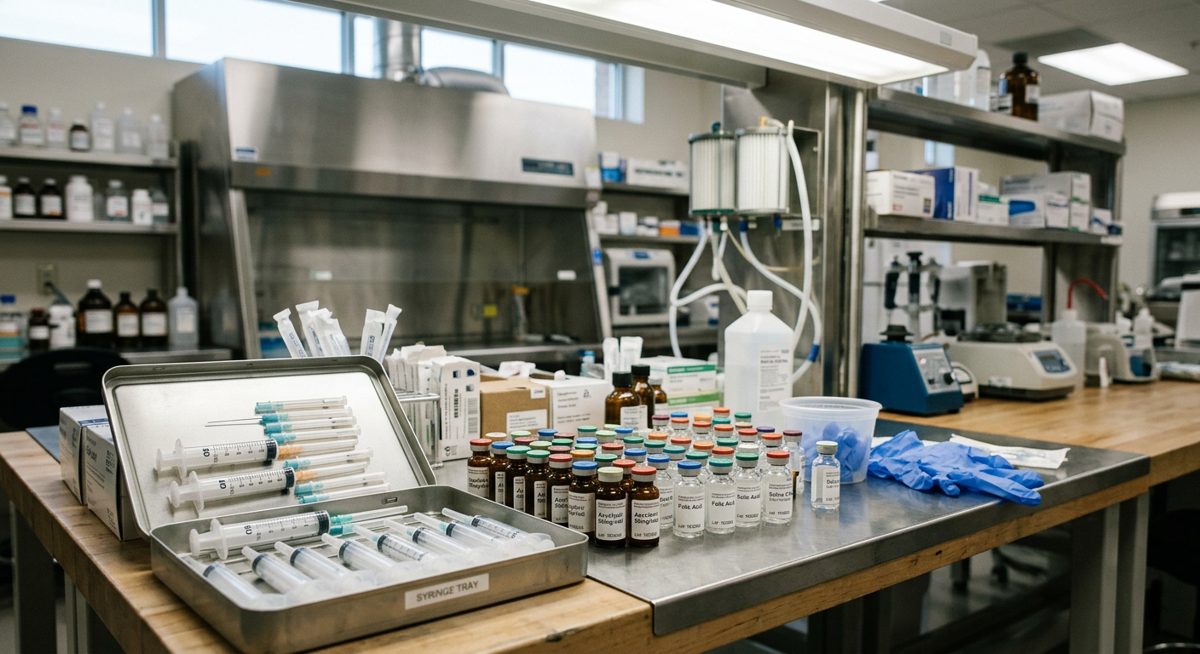
The most common and accessible entry point into the advanced pharmacy technician career track is sterile compounding. This specialty involves preparing medications in a controlled, sterile environment, typically for intravenous (IV) administration. It represents a significant leap in responsibility and skill from retail pharmacy, moving you from dispensing finished products to creating them. This work is primarily found in hospitals, infusion centers, and specialized compounding pharmacies. The transition is not just a change of scenery; it is a fundamental shift in your role from a customer service focus to a clinical production focus. The work is precise, methodical, and governed by strict protocols outlined in regulations like USP 797.
To formally enter this field, the Certified Compounded Sterile Preparation Technician (CSPT) credential is the industry standard. While the exam fee itself is a manageable cost, often under $200, the real investment is in the required training. Accredited training programs can range from a few hundred to a few thousand dollars. However, one of the biggest mistakes aspiring technicians make is assuming they must pay for this training out of pocket before they can get a job. The most effective strategy is to secure an entry-level pharmacy technician position at a hospital. Many health systems have their own in-house, accredited IV training programs and will pay for both the training and the certification exam for promising employees. They see it as a necessary investment to build a qualified team.
The pay increase associated with this move is substantial and immediate. A retail technician earning $18 per hour can realistically expect to make $22 to $25 per hour as a certified sterile compounding technician. In high-cost-of-living areas, this figure can be even higher. The timeline for this transition, starting from your first day in a hospital, is typically six to twelve months. During this initial period, your job is to master the basics of hospital pharmacy operations, demonstrate unwavering reliability, and express a clear interest in joining the IV room team. Managers look for technicians with excellent math skills, a keen eye for detail, and a calm demeanor, as the work requires intense focus.
Once you are selected for training, the process is rigorous. You will spend weeks learning aseptic technique, garbing procedures, cleanroom behavior, and complex calculations. A critical rule you will learn is that the process is just as important as the final product. Any break in technique, no matter how small, can compromise the sterility of the medication and lead to devastating patient harm. The consequence of failing to internalize this principle is not just a reprimand; it is a potential disqualification from the role and a serious mark on your professional record. Succeeding here proves you have the discipline required for even more advanced roles.
High-Stakes Skill: The Chemotherapy Compounding Niche
After mastering general sterile compounding, the next logical step up in complexity and compensation is specializing in chemotherapy preparation. This is one of the most demanding and respected roles a pharmacy technician can hold. It involves compounding hazardous drugs, primarily for cancer patients, in a specialized environment designed to protect both the medication and the preparer. The responsibility is immense, as dosing errors with cytotoxic agents can have immediate and severe consequences. This is not a role for everyone; it requires a unique combination of technical precision, mental fortitude, and a deep sense of purpose.
The pay for a chemotherapy technician reflects the high stakes of the work. While a general IV technician might cap out around $25 or $26 per hour, a proficient chemo tech can command $27 to $32 per hour, with senior or lead positions exceeding that. The path to this role almost exclusively runs through a hospital's inpatient or outpatient oncology pharmacy. External candidates without prior hazardous drug compounding experience are rarely considered. The training is extensive and always provided in-house, as it involves specific equipment, safety protocols, and software unique to the institution. While some technicians pursue additional credentials related to hazardous drug handling, the most valuable qualification is verifiable, hands-on experience.
A common mistake technicians make is underestimating the psychological weight of the job. You are preparing life-altering medications for critically ill patients, and you are constantly aware of the narrow therapeutic index of the drugs you are handling. A lapse in concentration cannot be tolerated. The environment is less about speed and more about absolute accuracy. A key rule is to never, under any circumstance, rush a process or bypass a safety check. Every calculation must be independently double-checked, every product meticulously inspected. The consequence of developing a cavalier attitude is swift removal from the role, as you become a liability to the patient, the pharmacy, and the entire hospital.
The timeline for moving into a chemo tech role after becoming proficient in general sterile compounding is typically another one to two years. It requires you to build a reputation for being the most meticulous, reliable, and detail-oriented technician in the IV room. You must actively seek out opportunities to learn, asking questions of the existing chemo team and expressing your interest to your manager. The best candidates are those who demonstrate an understanding of the gravity of the work before they are ever allowed to perform it. This role is a testament to the fact that a technician's job can be as clinically vital and professionally rewarding as any in the pharmacy.
Beyond the Bench: The Prior Authorization Specialist
For technicians who excel at organization, problem-solving, and communication, a career as a Prior Authorization (PA) specialist offers a path away from the dispensing bench and into a critical administrative function. This role is a linchpin in the healthcare system, ensuring patients can access expensive, life-sustaining specialty medications by navigating the complex and often opaque rules of insurance payers. PA specialists work in various settings, including large physician clinics, hospital outpatient pharmacies, specialty pharmacies, and for the insurance companies themselves. They become experts in clinical guidelines, payer-specific formularies, and the art of constructing a compelling case for medical necessity.
The transition to a PA role leverages the clinical knowledge gained as a technician but applies it to a different domain. Instead of compounding a drug, you are arguing for why it should be covered. The daily work involves reviewing patient charts, communicating with doctors' offices to gather necessary clinical documentation, filling out detailed forms, and spending significant time on the phone with insurance case managers. Success in this role is measured by tangible metrics: approval rates and turnaround times. A skilled PA specialist can significantly reduce delays in therapy for patients and prevent thousands of dollars in lost revenue for their employer. This direct impact on both patient care and business operations makes the role highly valued.
The compensation for PA specialists is competitive, often ranging from $24 to $29 per hour. Many of these positions are structured as standard business-hour, Monday-to-Friday jobs, offering a better work-life balance than the round-the-clock schedules of hospital pharmacy. A critical rule for success is mastering the language of documentation. Every claim must be supported by precise, irrefutable evidence from the patient's medical record. A common mistake is submitting incomplete or poorly organized requests, which leads to automatic denials and creates frustrating rework. The consequence is not just a delayed prescription; it erodes the trust of prescribing physicians and can harm the pharmacy's reputation.
Getting into this specialty often requires at least two to three years of solid pharmacy experience, ideally with some exposure to specialty drugs or complex insurance rejections. A technician working in a retail or hospital pharmacy who consistently takes the initiative to resolve difficult third-party claims is building the perfect resume for a PA role. You can actively prepare by becoming the go-to person in your department for troubleshooting insurance issues. When a position opens up, you can then point to a track record of successfully overturning denials and facilitating patient access, making you a much stronger candidate than someone with only dispensing experience. This path transforms you from a task-doer into a strategic problem-solver.
The Logic of Logistics: Inventory and 340B Programs
For the analytically-minded technician who finds satisfaction in systems, efficiency, and financial stewardship, a career in pharmacy inventory management is a lucrative and challenging path. This goes far beyond simply ordering stock. In a hospital setting, it involves managing a multi-million dollar asset, minimizing waste, ensuring drug availability for critical patient needs, and navigating complex purchasing contracts. The pinnacle of this specialty is managing a 340B Drug Pricing Program, a federal initiative that allows eligible hospitals and clinics to purchase outpatient drugs at a significant discount. A technician who can master this complex regulatory landscape becomes an indispensable financial asset to their organization.
A 340B Coordinator or Analyst role is one of the highest-paying positions a technician can achieve without moving into formal management. It is not uncommon for experienced 340B specialists to earn salaries ranging from $55,000 to $75,000 per year, and sometimes more in large health systems. These roles require a unique blend of pharmacy knowledge, data analysis skills, and an auditor's mindset. The work involves meticulously tracking drug purchases, dispensing records, and patient eligibility to ensure every single dose accounted for under the 340B program is compliant with federal law. You are no longer just handling vials; you are safeguarding the financial integrity of the pharmacy department.
The most significant mistake one can make in this field is becoming complacent about compliance. The 340B program is subject to rigorous audits by the Health Resources and Services Administration (HRSA). A failed audit can have devastating financial consequences for a hospital, including being forced to repay millions of dollars in discounts to drug manufacturers. A single, seemingly minor error in purchasing or dispensing—such as giving a 340B-purchased drug to an ineligible patient—can be flagged by an auditor. If that error points to a systemic flaw in the pharmacy’s processes, the penalties can be severe. The core rule of 340B is to always be audit-ready, with immaculate records and justifiable processes for every transaction.
The pathway to an inventory or 340B role begins with demonstrating an interest and aptitude for the business side of the pharmacy. As a staff technician, you can volunteer to help with cycle counts, investigate stock discrepancies, or assist the current inventory manager with returning expired medications. This shows initiative and gets you familiar with the procurement software and processes. It typically takes a few years of general hospital experience to be considered for these roles, as you need a deep understanding of the hospital's medication use patterns. This career transforms you from a participant in pharmacy operations to a manager of its core financial engine.
Get new remote pharmacy jobs sent to your inbox.
We check the employer career pages in this article every day and email you the new openings — with the real apply link, not a repost. 958 live right now.
Free. Unsubscribe any time.
The Digital Pharmacy: A Career in Informatics
As healthcare becomes increasingly dependent on technology, a specialized career path has emerged for pharmacy technicians in informatics. This field is the bridge between clinical pharmacy practice and information technology. A pharmacy informatics technician helps manage the complex web of software that runs a modern pharmacy, including the electronic health record (EHR), automated dispensing cabinets, IV workflow software, and inventory systems. This is the ideal track for the tech-savvy problem-solver who is more interested in why the scanner is not working than in what it is scanning. It’s a role that focuses on systems and logic to make the work of the entire department safer and more efficient.
Informatics technicians are not coders or programrs, but they possess a deep, functional understanding of how their pharmacy’s software works. Their daily tasks might include building new drug files in the system, troubleshooting order-entry problems, training new staff on the EHR, and helping to test software upgrades before they go live. This position requires strong analytical skills, meticulous attention to detail, and the ability to communicate technical concepts to non-technical staff. The pay for these roles reflects their specialized nature, with entry-level informatics technicians often starting around $28 per hour and senior specialists easily earning over $70,000 per year.
A critical timing detail for entering this field is to get involved during a major technology project. When a hospital implements a new EHR or upgrades its pharmacy system, it creates a massive, temporary need for support and training. This is a golden opportunity. Volunteering to be a "super user" or to assist the project team gives you invaluable experience and direct exposure to the informatics department. It is effectively a months-long job interview. Many informatics technicians get their start this way, proving their value during a project and then being offered a permanent position once the implementation is complete. A common mistake is waiting for a formal job posting; the proactive technician creates the opportunity by becoming essential during a time of change.
The value of a good informatics technician cannot be overstated. A well-built medication entry in the EHR can prevent countless ordering errors by prescribers. A smoothly functioning automated dispensing cabinet system reduces the risk of medication errors on the nursing units. The consequence of poor informatics work is systemic inefficiency and patient safety risks embedded directly into the workflow. Success requires a specific mindset: you must be able to see the entire medication use process, from the physician's order to the patient's bedside, and understand how technology can either help or hinder it. This career path allows you to impact patient safety on a macro level, influencing thousands of medication orders every single day.
Forging Your Two-Year Advancement Plan
Escaping the retail pharmacy grind and building a high-paying, specialized career is a two-year project, not a single leap. It requires a deliberate, phased approach that starts with changing your environment and ends with targeted specialization. The entire plan hinges on getting out of the retail setting and into a hospital or health system pharmacy, which serves as the training ground for virtually all advanced technician roles. This initial move is the most important step you will take. It may not come with a dramatic pay raise, but it grants you access to the clinical ecosystem where your true career growth will happen. Your first year should be dedicated entirely to securing a hospital position and mastering its core functions.
During this first year, your primary objective is to become a model employee. This means demonstrating perfect attendance, a positive attitude, and an eagerness to learn all facets of inpatient pharmacy operations, from cart fills to unit-stocking to basic IV admixture. While doing this, you must be an active observer. Pay attention to the different specialty areas. Does the methodical precision of the IV room appeal to you? Are you intrigued by the problem-solving of the prior authorization team? Do you find yourself asking the inventory manager questions about ordering processes? This year is for exploration and self-assessment, allowing you to identify which advanced path aligns with your natural skills and interests while you build a reputation for competence and reliability.
The second year is for execution. Having established yourself as a dependable team member, you now have the credibility to ask for opportunities. Approach your manager and express a clear, informed interest in a specific area. Ask if you can be cross-trained in the sterile compounding suite. Volunteer to become a super user for the pharmacy software to get a taste of informatics. Offer to help the 340B coordinator with an audit preparation task. This is how you pivot internally. By the end of year two, your goal is to be officially enrolled in a training program or have transitioned into a junior role within your chosen specialty, such as a Compounding Technician, an Inventory Assistant, or a Prior Authorization Trainee. You are now on the ladder.
Your immediate action this week is to ground this plan in reality. Do not simply think about it; start the research. Identify the three largest hospital systems within a reasonable commute of your home. Navigate to their career websites and search for "Pharmacy Technician" positions. Scrutinize the job descriptions for entry-level roles, often titled "Pharmacy Technician I" or simply "Pharmacy Technician." Look for keywords like "IV admixture training provided," "opportunity for advancement," or "varied duties in central and decentralized pharmacy." This is your way in. Apply to these positions, even if they feel like a lateral move. This is the first concrete step in your two-year plan to leave the counter behind and build a career you can be proud of.
As an Amazon Associate we earn from qualifying purchases. Product availability and prices on Amazon change frequently and anything shown here may be out of date by the time you click. How we pick our recommendations.