
Jobs to Inbox is a participant in the Amazon Services LLC Associates Program. When you buy through links on this page we may earn a commission, at no extra cost to you. We choose every product ourselves and we are never paid to include one. How we pick.
The Shift from Bedside Presence to Remote Judgment
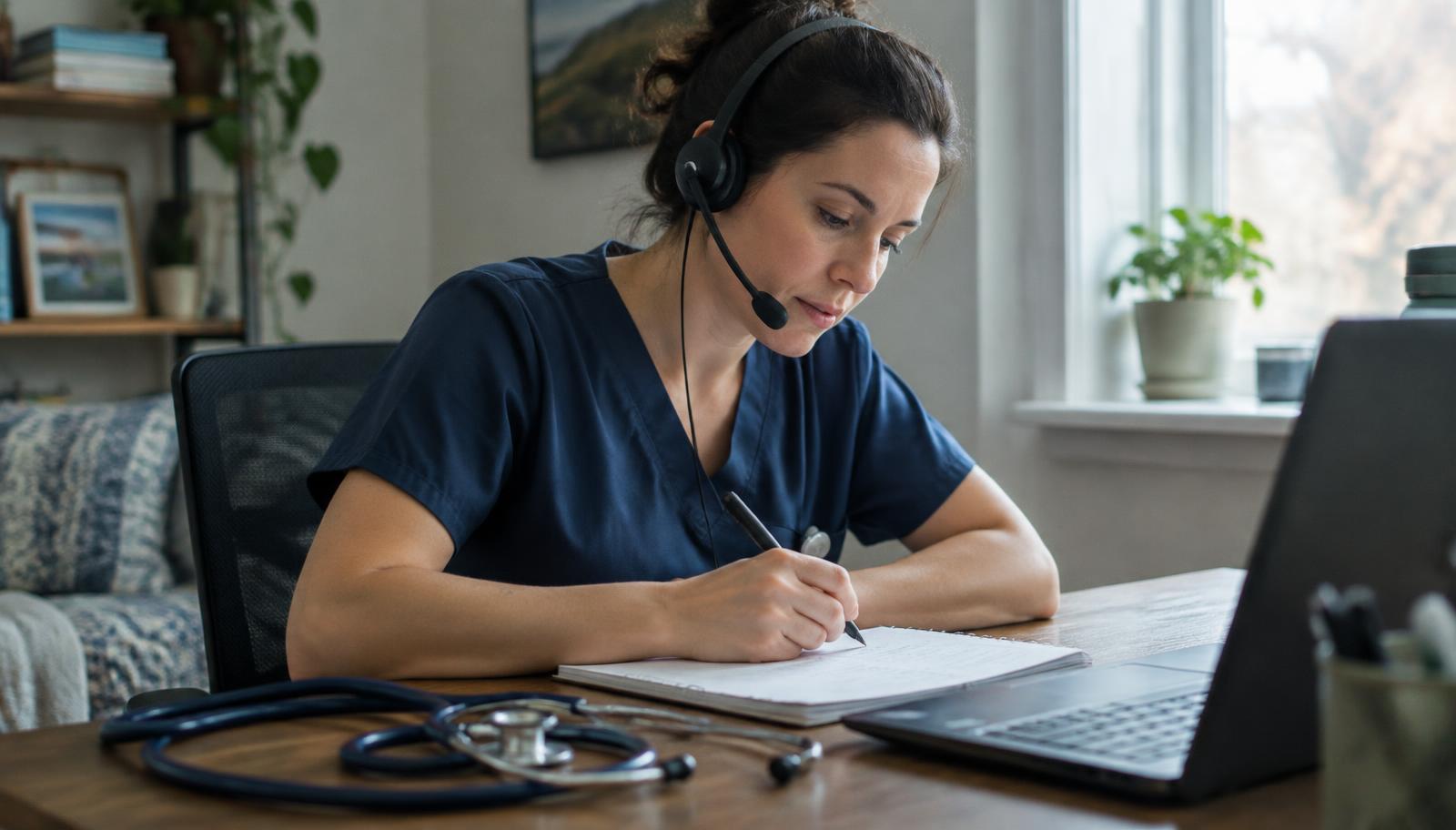
The most significant challenge for a nurse transitioning from the constant motion of a clinical floor to the focused quiet of a home office is not learning new software, but unlearning the rhythm of physical presence. At the bedside, assessment is a multi-sensory experience driven by sight, sound, touch, and even smell, often performed in a flurry of concurrent tasks. Remote nursing shifts the emphasis from hands-on assessment to interpreting records and communicating at a distance. Clinical judgment remains central, but you must recognize the limits of the information available and when an in-person assessment is needed. This transition is less about changing your core nursing skills and more about changing the medium through which you apply them.
This adjustment involves learning to synthesize information from digital charts, phone interviews, and written documentation without an in-person assessment. Remote nurses need confidence and independence, but they do not work without clinical support. Employers should provide escalation procedures and access to supervisors or other clinicians. You must know when to seek help, manage your time, and document assessments and decisions clearly. Employers value both sound judgment and the ability to collaborate effectively from a distance.
Avoiding the physical demands of bedside shifts and a daily commute motivates many nurses to seek remote work. But working from home does not guarantee control over your schedule: triage and other services may require fixed shifts, evenings, weekends, or holidays. The most successful remote nurses are those who structure their day with the same seriousness as a hospital shift, creating a dedicated workspace, setting clear boundaries with family, and developing routines that foster focus and productivity. The work is different, but the level of professionalism required remains just as high, if not higher.
What Experience Do Employers Want for Remote RN Jobs?
Remote RN employers often require recent clinical experience, especially for triage and complex case management. Requirements vary: some accept one or two years, while others ask for three to five years or relevant specialty experience. In a remote setting, a nurse cannot rely on a quick physical check or the immediate backup of a rapid response team. Instead, they must draw upon a deep well of clinical memories, pattern recognition, and instinct honed by years of hands-on experience. This seasoned judgment allows a remote registered nurse to identify subtle signs of patient deterioration from a conversation, recognize inconsistencies in a medical record, and ask the probing questions that uncover critical information. Your bedside years are the foundation upon which your remote credibility is built.
General medical-surgical experience is valuable, and specialty experience can help when it matches the patient population. Backgrounds in critical care, emergency nursing, labor and delivery, or oncology may support a move into triage or complex case management, though role-specific training is still needed. These high-acuity environments force nurses to become experts in prioritization, rapid decision-making, and clear communication under pressure—all prized attributes for an autonomous remote position. If you have experience in one of these areas, it is essential to highlight not just the tasks you performed, but the decision-making processes you owned. Describe problems you solved, decisions you made within your scope, and situations where you escalated concerns appropriately.
Beyond clinical expertise, employers are searching for specific soft skills that predict success in an independent role. You must be demonstrably self-motivated, organized, and an excellent time manager. Your resume and cover letter should provide concrete examples of these traits. Did you serve as a preceptor, train new staff, or lead a unit-based council? These activities demonstrate leadership, accountability, and the ability to work without constant supervision. Furthermore, a high degree of technological comfort is non-negotiable. While you do not need to be a coding expert, you must be proficient in navigating electronic health records, using multiple software platforms simultaneously, and troubleshooting basic computer issues. This digital literacy is the modern equivalent of knowing how to find supplies on a new unit; it is an essential competency for getting the job done efficiently.
A Deeper Dive into Key Remote Nursing Roles: Triage and Utilization Review
Among the most common entry points into the world of remote nursing are the fields of telephonic triage and utilization review (UR). While both are non-bedside roles, they represent two distinct career paths requiring different skill sets and temperaments. Telephonic triage is a fast-paced, patient-facing role where you are the first point of clinical contact for individuals seeking medical advice over the phone. Using standardized protocols and your own sharp assessment skills, you quickly evaluate a patient's symptoms, determine the appropriate level of care, and provide clear, actionable instructions. This job requires the poise of an emergency department nurse, the patience of a teacher, and the ability to build rapport and trust with an anxious person you have never met.
The work is highly structured and often involves sophisticated software to guide and document your assessments. A successful triage nurse can deftly navigate these systems while actively listening to a patient, creating a sense of calm and control in a potentially chaotic situation. Documentation is meticulous and immediate, as your notes form a critical part of the patient's record and justify your clinical decisions. Triage can suit nurses who enjoy quick problem-solving and direct patient interaction by phone or video. The satisfaction comes from resolving an immediate need and ensuring a patient gets to the right place at the right time, preventing unnecessary emergency visits or, conversely, identifying a true medical emergency that requires immediate intervention.
In contrast, utilization review is an analytical, system-focused role that positions the nurse as a patient advocate and a steward of healthcare resources. UR nurses work for insurance companies, hospital systems, or third-party administrators to review patient cases against established clinical guidelines. They assess whether admissions, continued stays, procedures, and services meet medical-necessity and coverage criteria. Their reviews can affect authorization and payment; cases that do not meet criteria may require review by a physician or another qualified clinician under applicable rules and employer procedures. The role requires a deep understanding of evidence-based practice, insurance criteria, and the healthcare continuum.
A typical day for a UR nurse involves reviewing electronic medical records, comparing clinical data with standardized medical-necessity criteria, and contacting the care team for more information or to discuss a patient's plan. It requires a detective's eye for detail and the ability to construct a clear, concise clinical argument in writing. While there is less direct patient contact, the role has a significant impact on patient safety and healthcare costs. It is a perfect fit for nurses who are highly analytical, enjoy research and documentation, and are passionate about the "why" behind clinical decisions. This path offers a way to leverage extensive clinical knowledge to influence the healthcare system on a macro level.
Exploring Opportunities in Case Management and Care Coordination
Remote case management and care coordination overlap, and employers use the titles differently, so the duties matter more than the label. Remote case management is typically a longitudinal process focused on a specific population of patients, often those with complex or chronic conditions like diabetes, heart failure, or COPD. As a case manager, you serve as a central point of contact, advocate, and educator for your assigned patients. You work telephonically to help them understand their disease, adhere to their treatment plans, navigate the healthcare system, and access community resources. This is a holistic, relationship-based role that can span months or even years.
The goal of a remote case manager is to empower patients to manage their own health, thereby improving their quality of life and reducing hospital readmissions. Your day might involve calling a post-discharge patient to review their medications, coaching someone through a new diet and exercise plan, or coordinating with their primary care provider and various specialists to ensure everyone is on the same page. Success in this field requires exceptional communication and motivational interviewing skills, empathy, and a talent for long-term planning and organization. The work can appeal to nurses who enjoy building lasting connections and helping patients develop sustainable health routines.
Some care coordination positions focus on a specific event or transition, while others involve ongoing support. A remote care coordinator might be responsible for ensuring a patient has a smooth discharge from the hospital to a rehabilitation facility, or for managing the logistics of a complex surgical plan. This role is highly logistical and requires meticulous attention to detail and an ability to juggle multiple moving parts. You might spend your day arranging follow-up appointments, verifying insurance authorizations for durable medical equipment, and communicating the plan to the patient, their family, and the entire care team. It is the ultimate project management role within nursing.
Transition-focused roles require strong organizational skills and effective communication with physicians, schedulers, patients, and family caregivers. Both case managers and care coordinators advocate for patients, and their responsibilities may overlap substantially. Check whether a position emphasizes discharge logistics, ongoing disease management, or both.
The Specialized Paths: Quality, Informatics, and Education
Beyond the more common roles in triage and case management, a rich world of specialized remote nurse careers awaits those with the right experience and interests. The field of Quality Improvement (QI), for example, offers a chance to impact patient care on a systemic level. Remote QI nurses typically work for healthcare systems or payers, performing detailed chart audits to ensure compliance with clinical standards, regulatory requirements, and evidence-based practices. They analyze data to identify trends in patient outcomes, pinpoint areas for process improvement, and help develop and implement strategies to enhance safety and quality across an entire organization. This role is perfect for the meticulous, detail-oriented nurse who enjoys data analysis and has a passion for making the entire system work better for every patient.
Nursing informatics is another specialized path. This field sits at the intersection of clinical practice, information science, and technology. An informatics nurse acts as a translator between the clinicians at the bedside and the IT professionals who build and maintain healthcare software. They play a crucial role in optimizing electronic health record (EHR) systems, designing clinical workflows that are both safe and efficient, and training staff on new technologies. Some informatics roles are fully remote, with tasks such as building order sets, analyzing system usage, and supporting users virtually; others require onsite training or implementation work. For nurses with technical interests, analytical skills, and a knack for teaching, informatics offers a path away from direct patient care.
Nursing education also offers remote opportunities, both within and outside academia. Many organizations hire remote nurse educators to create patient education materials, develop clinical training modules for staff, or even provide one-on-one virtual coaching for new employees. Online instructors may teach and mentor nursing students virtually, although faculty roles often require a graduate degree and may include onsite clinical responsibilities. These positions allow seasoned nurses to share their wealth of knowledge and shape the next generation of caregivers. This path is ideal for nurses with a passion for mentorship, strong communication skills, and the ability to distill complex clinical information into clear, understandable content.
Navigating Licensure: The Compact and State-by-State Rules
A critical logistical hurdle every aspiring remote nurse must understand is licensure. The rules governing your ability to practice are just as important in a remote setting as they are in a hospital, and they can significantly impact your job prospects. The most important concept to grasp is the Nurse Licensure Compact (NLC). The NLC allows eligible RNs and LPNs/VNs whose primary state of residence participates in the compact to obtain a multistate license and practice in other states where the compact is operational, including remotely. Living in a compact state does not automatically make a license multistate; nurses must meet the eligibility requirements. The privilege depends on where nursing practice occurs, not simply where the employer is headquartered.
If your primary residence is in a non-compact state, you generally cannot obtain an NLC multistate license. You may need additional single-state licenses by endorsement wherever your work requires practice authority. Even with a multistate license, you generally need a separate license to practice in a non-compact state. This process can be time-consuming and costly, involving applications, background checks, and fees. Some employers are willing to hire nurses who need to obtain a new license and may even reimburse the costs, but many prefer candidates who are already licensed and ready to work. It is crucial to read job descriptions carefully; they will almost always specify the licensure requirements, such as "must have an active Florida license" or "NLC multistate license required."
For direct telehealth care, including telephone triage, you generally need legal authority to practice where the patient is physically located during the encounter, through a state license, an applicable compact privilege, or a specific legal exception. Your own work location may create additional requirements. Verify patient location and follow the employer's procedures before providing care. For utilization review, quality, and informatics, requirements depend on the duties and applicable state laws; the employer's headquarters is not a reliable shortcut. Check current compact implementation status and confirm role-specific requirements with the employer and relevant boards of nursing.
Understanding Pay Bands for Remote Registered Nurse Jobs
Compensation is a common concern for nurses considering remote work. Remote roles do not automatically pay less than onsite positions, but comparisons should account for benefits, hours, overtime eligibility, and shift differentials. An experienced bedside nurse may earn less in a first remote role if it requires skills they are still developing. Relevant utilization review, case management, or informatics experience may matter more to an employer than total years in nursing.
The primary drivers of pay for remote registered nurse jobs include the specific role, your years of relevant experience, and the employer's geographic location. Specialized roles like nursing informatics or those requiring an advanced degree often command higher salaries than entry-level remote positions. Experience that directly matches the role can strengthen your negotiating position. Geography also matters, but employers may base remote pay on the employee's location, a regional market, or a national range rather than their headquarters. A company in an expensive city does not necessarily offer that city's rates to every remote employee.
It is also important to understand the different compensation philosophies companies adopt for remote work. Some employers use a national pay range for a remote role, with individual offers still varying by experience and other job-related factors. This can be a significant financial advantage for a nurse living in a low-cost-of-living area. Other companies use location-based pay, adjusting the salary based on the employee's home address. When evaluating an offer, it is critical to look at the total compensation package, including salary, benefits, retirement contributions, and potential bonuses. Compare compensation alongside workload, schedule, and career goals rather than focusing on salary alone.
Get new remote RN jobs sent to your inbox.
We check the employer career pages in this article every day and email you the new openings — with the real apply link, not a repost. 1,926 live right now.
Free. Unsubscribe any time.
Beyond the RN: Remote Paths for LPNs and Nurse Practitioners
Remote nursing roles also exist for licensed practical nurses (LPNs, called LVNs in some states) and nurse practitioners (NPs). LPN options are generally narrower than RN options because their scope of practice differs. Remote LPN jobs often focus on tasks that support the broader care team. Duties may include collecting patient information by phone, gathering medication histories for reconciliation, scheduling appointments, processing referrals, and providing education within established plans. Permitted tasks and supervision requirements depend on state law and employer policy; independent triage or comprehensive assessment may fall outside an LPN's scope.
Remote LPN pay is generally lower than remote RN pay and varies by duties, employer, location, and experience. These positions can reduce physical demands, but work-life balance depends on the schedule, workload, and performance expectations. Experience in a physician's office or clinic setting is often highly valued for these positions, as it demonstrates proficiency in the exact administrative and patient communication tasks that make up the core of many remote LPN jobs. It is a viable path for those looking to continue using their license in a new and flexible way.
NPs can provide virtual primary care, urgent care, and specialty consultations. Duties may include diagnosing and treating conditions, managing chronic illness, prescribing medications, and ordering tests when appropriate for telehealth. Practice requires applicable state APRN authority and compliance with collaboration, supervision, and prescribing rules, including federal and state restrictions on controlled substances. An RN multistate license alone does not authorize NP practice across state lines. NPs may also find remote positions in leadership, education, and advanced clinical review. An NP might work remotely as a clinical director for a telehealth startup, a consultant for a healthcare technology company, or a senior reviewer for an insurance firm. The combination of advanced clinical autonomy and technological platforms makes the NP role exceptionally well-suited for the remote environment.
Preparing Your Application for the Remote Environment
A strong remote nursing application connects your clinical background to the employer's specific needs. Before applying, review the duties, patient population, schedule, licensing requirements, and any travel expectations. Tailor your materials to show how your experience prepares you for those responsibilities. Once you have identified a promising role, your resume becomes your single most important tool for making a strong first impression. It must do more than simply list your previous duties; it must translate your bedside experience into the language of remote work.
Rather than relying on a generic template, use your resume to demonstrate sound judgment, clear communication, and reliable independent work. For every bullet point, ask yourself how it demonstrates skills valuable in a remote setting. For example, if accurate, expand "Managed a medical-surgical caseload" to "Assessed patients, prioritized interventions, coordinated care, and escalated changes in condition across a medical-surgical caseload." This highlights clinical judgment and teamwork without overstating independence. Quantify accomplishments only when you have reliable records to support them. Otherwise, describe your contribution to a safety initiative and how its results were evaluated without inventing a percentage or claiming sole credit. Your goal is to paint a picture of a nurse who is not just a task-doer but a self-starting clinical leader.
If you land an interview, be prepared to answer nursing interview questions designed to probe your suitability for remote work. Expect questions about how you handle ambiguity, how you manage your time when unsupervised, and how you would resolve a clinical problem without a team physically present. They want to hear about your comfort level with technology and your ability to communicate with exceptional clarity, both verbally and in writing. Prepare specific examples from your past experience that illustrate these competencies. Practice telling a story about a time you had to learn a new EHR system quickly or a time you successfully de-escalated a difficult patient situation over the phone. Specific examples help interviewers assess how you might handle the demands of remote work.
Building Your Remote Nursing Career for the Long Term
Landing your first remote nursing job is a significant achievement, but it is only the beginning of a new career trajectory. Thriving in a remote role long-term requires a proactive approach to professional growth and personal well-being. One of the biggest risks of working from home is career stagnation and professional isolation. Without the daily interactions of a hospital unit, you miss out on informal learning opportunities and the camaraderie of a shared experience. To combat this, you must be intentional about staying connected and relevant in your field. Actively seek out virtual networking opportunities, join professional organizations focused on your specialty, and connect with your remote colleagues through company channels.
Continual learning is non-negotiable. Consider relevant credentials, such as Certified Case Manager (CCM) or informatics nursing certification, after checking their current education, licensure, and experience requirements. Take advantage of any tuition reimbursement or professional development funds your employer offers. Stay current with clinical guidelines and emerging healthcare technologies. Relevant learning can strengthen your work and support advancement into leadership or specialized positions. Don't be afraid to schedule regular check-ins with your manager to discuss your career goals and ask for opportunities to take on new projects or responsibilities. You are your own best advocate for advancement.
As you compare remote RN positions, prioritize roles that match your license, experience, and preferred schedule. Ask about orientation, clinical escalation support, productivity targets, and equipment before accepting an offer. These details matter as much as the ability to work from home.
Your concrete step for this week is to choose one key responsibility from your current or most recent bedside role and rewrite it on your resume three different ways. Each version should be tailored to a different type of remote job—one for triage, one for utilization review, and one for case management. Focus on using action verbs that highlight autonomy, critical thinking, and communication. This simple exercise will strengthen your resume and sharpen your understanding of how to market your invaluable experience for the remote world.
As an Amazon Associate we earn from qualifying purchases. Product availability and prices on Amazon change frequently and anything shown here may be out of date by the time you click. How we pick our recommendations.